What Age Should You Start Toilet Training a Toddler?
What is the optimal age to begin potty training a child?
Most children develop physiological bladder capacity and neuromuscular readiness for toilet training between 18 and 30 months of age. Starting when a child demonstrates readiness signals—staying dry for 2 hours and communicating wet diapers—leads to faster daytime success than arbitrary calendar milestones.
Physiological & Developmental Foundations
Pediatricians and child psychologists have debated the ideal toilet training age for decades. In the mid-20th century, rigid training before 12 months was common; by the 1980s, child-oriented approaches advocated waiting until after age 3. Contemporary pediatric urology demonstrates that the optimal developmental window lies between 22 and 30 months.
Prior to 18 months, spinal cord pathways connecting the cortex to the external urethral sphincter are incompletely myelinated. Involuntary spinal reflexes govern bladder emptying whenever the detrusor muscle senses stretch. Attempting to train an infant under 18 months trains the caregiver to catch voids rather than training the child to consciously control sphincters.
Conversely, waiting until after 36 months significantly elevates the risk of oppositional power struggles, stubborn stool withholding, and prolonged daytime wetting. Between 22 and 28 months, toddlers are physiologically capable, eager to imitate adult behavior, and have not yet entered the peak period of three-year-old stubborn defiance.
Step-by-Step Practical Protocol
- 1. Confirm Bladder Storage Capacity:Observe whether your child stays dry for at least 1.5 to 2 hours during active play or naps. This indicates the detrusor muscle can store urine under healthy autonomic control.
- 2. Evaluate Fine and Gross Motor Skills:Ensure your toddler can walk steadily into the bathroom, sit down on a low chair unassisted, and pull loose pants down over their hips.
- 3. Check Receptive Language Comprehension:Confirm your child understands two-step instructions like: 'Walk to the bathroom and sit on the potty.' They do not need fluent speech, but must understand basic concepts.
- 4. Identify Elimination Awareness Gestures:Notice if your child pauses play, hides behind furniture, squats, or gestures to their diaper when voiding. This signals conscious interoceptive awareness.
- 5. Input Age and Readiness Markers into Your App:Record your child's age in months inside your tracking tool to calibrate interval recommendations tailored to their developmental capacity.
Clinical Insights & Edge Cases
Avoid beginning toilet training during major family upheavals—such as the arrival of a new baby, a household move, weaning from breastfeeding, or starting a new daycare. Introducing bathroom expectations during emotional transitions increases the likelihood of refusal and regressions. Wait for a stable 3-week window of domestic calm.
Common Obstacles and Hidden Friction Points
"Initiating toilet training between 24 and 30 months correlates with the shortest overall duration to complete daytime dryness (average 4.5 weeks)."
Waiting for a child to spontaneously ask to use the toilet without adult prompting leads many parents to delay training past 3.5 years, increasing kindergarten diaper delays.
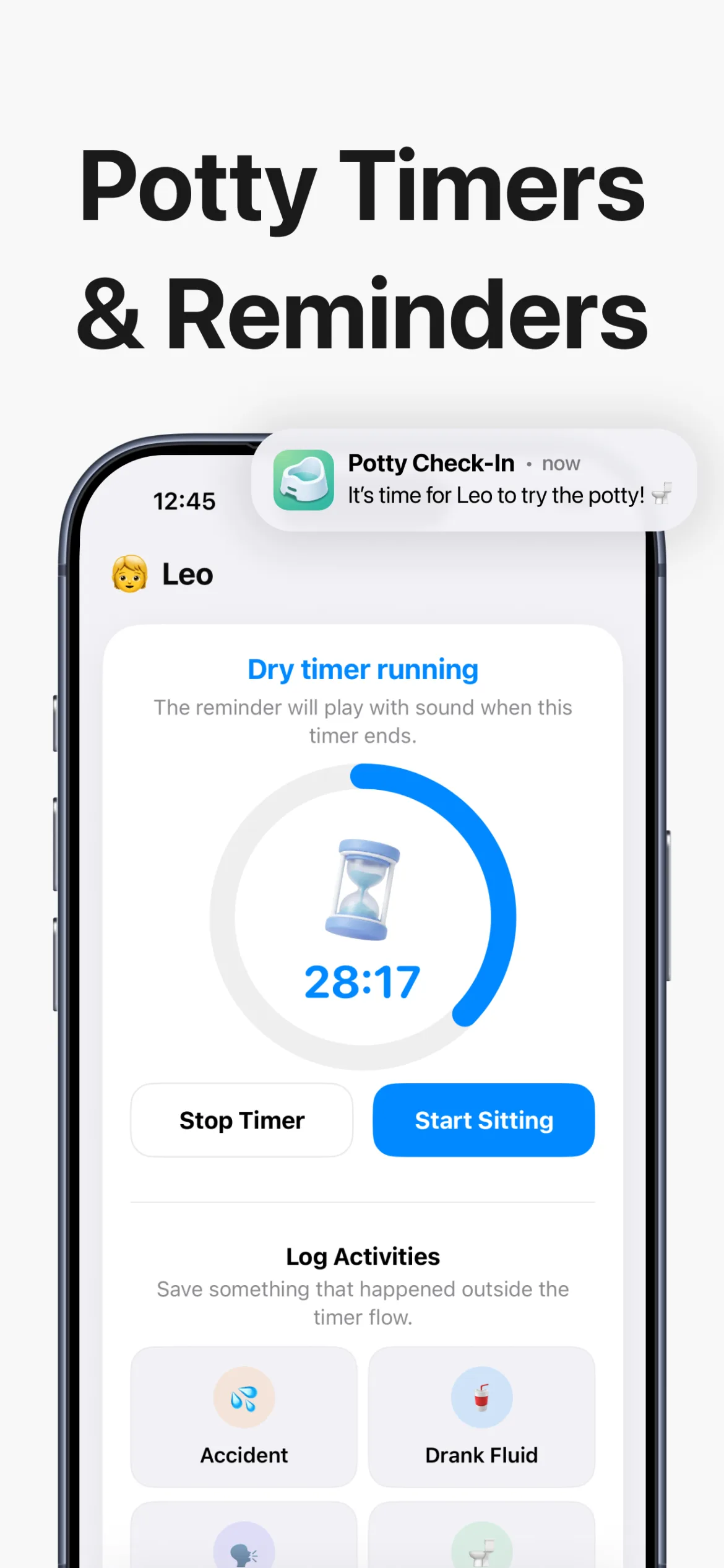
Automate This in 1 Tap with Potty Training App
Potty Training App calibrates dry intervals based on your child's exact age in months, helping you launch an age-appropriate routine the moment developmental readiness appears. Runs 100% offline using CoreData local SQLite storage, eliminating cloud latency and protecting child privacy.